Cash Taken at a Customer’s Home: Receipts at the Door, a Count Before You Leave and the Van That Is Not a Safe
A home visit has no till, no safe and no second person, and that is exactly why the cash taken there needs the firmest routine of all. A cash taken customer home receipt count van safe routine fixes that at the doorstep: a receipt is given for every cash payment, the money is counted before leaving the property, and it goes into a locked box, never a pocket or the glovebox, until it is banked.
A cash taken customer home receipt count van safe routine that starts at the door
The routine begins before the van leaves the yard, with a receipt book, a lockable cash box, and a pen that works. The receipt book should have numbered pages, so a missing page can be spotted, and the cash box should lock with a key that stays with the worker, not in the van’s ignition.
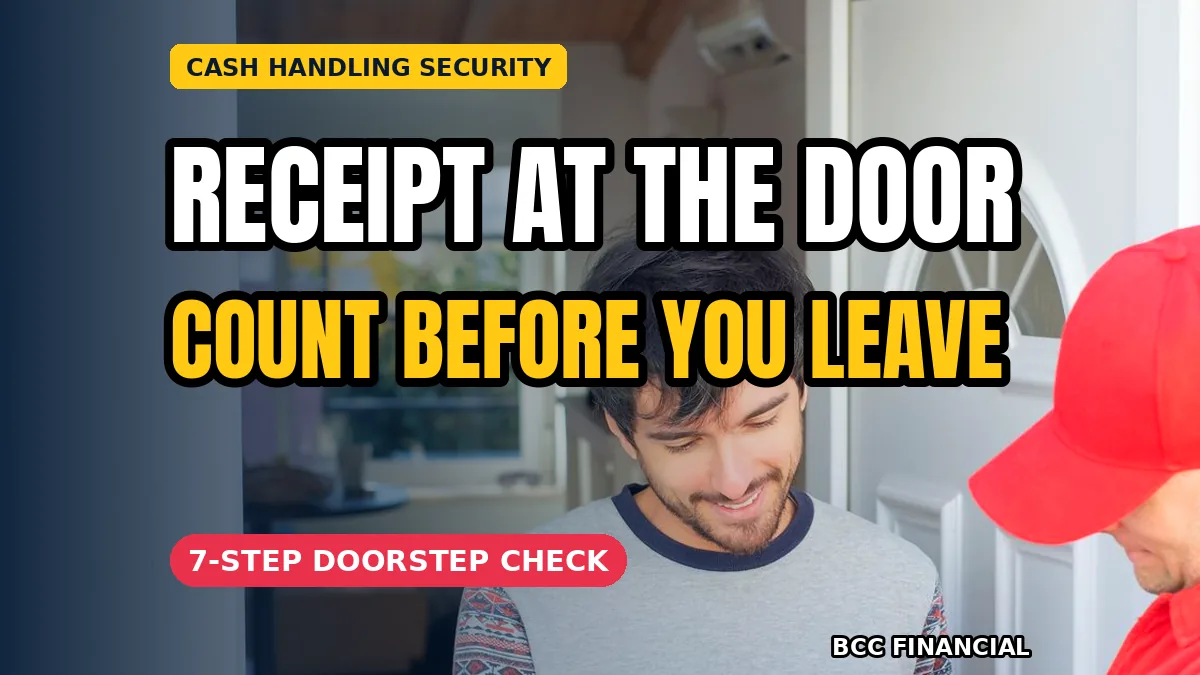
- Take a numbered receipt book and a lockable cash box on every home visit.
- Write the receipt at the door, with the customer name, the job and the amount.
- Give the customer the top copy and keep the duplicate in the book.
- Count the cash in front of the customer, before leaving the property.
- Put the money straight into the locked cash box, never into a pocket or the glovebox.
- Record the payment in the day book on return, with the receipt number.
- Bank the takings the same day, and never leave cash in the van overnight.
The Receipt at the Door: Given for Every Payment
A receipt given at the door is the only proof the payment happened. A cash taken customer home receipt count van safe habit writes the receipt while still standing with the customer: the name, the job, the amount, and the date, in words the customer can read. The customer keeps the top copy, the duplicate stays in the book, and both copies carry the same number, so the payment can be matched from either side.
Never promise to send the receipt later. A receipt promised for later is a receipt that may never be written, and a customer who has paid cash with no receipt has every reason to ask for the payment again. A cash taken customer home receipt count van safe visit ends at the door, while the money is still in your hand, with both sides holding the same fact.
The Count Before You Leave the Property
Count the money before leaving the property, in front of the customer, and say the amount out loud. A cash taken customer home receipt count van safe count takes a moment, and it settles the two questions that cause the most arguments: whether the amount handed over was the amount agreed, and whether the change given was right.
If the amount is wrong, say so at once and sort it out there. A shortfall found at the door is a mistake, while a shortfall found at the yard is an accusation, and nobody benefits from that.
The Van That Is Not a Safe
The van is transport, not storage, and the cash box is the only safe the visit has. A cash taken customer home receipt count van safe habit puts the money into the locked box the moment the count is done, and the box stays locked until the takings are banked. Our guide to cash routines for lone workers shows how a worker on their own keeps cash and safety together.
Never leave cash in the van overnight, and never leave it in the glovebox, under a seat, or in a door pocket, even for an hour. A cash taken customer home receipt count van safe routine banks the takings the same day where that is possible, and where it is not, the locked box goes inside with the worker, not left in the van. Our guide to securing cash in the van explains how takings are kept safe between stops, and the Canadian Centre for Occupational Health and Safety guidance on working alone off-site sets out lone-worker safety off-site.
When the Customer Cannot Pay on the Day
Sometimes the customer cannot pay on the day, and the routine should have an answer ready. A cash taken customer home receipt count van safe visit that ends without payment should still end with a paper trail: a note of the amount owed, the reason it was not paid, and the date agreed for payment, signed by the customer if they will. The visit is then a debt with a date, not a favour that will be forgotten.
Do not take goods or tools as security for an unpaid bill. Holding a customer’s belongings against payment creates a dispute that is worse than the debt, and it can turn a simple late payment into a complaint that follows the business.
FAQ
Should the receipt show the whole job price or only the amount paid?
Both, where the payment is only part of the price. A cash taken customer home receipt count van safe receipt should show the amount paid today and the balance still owed, so the customer can see at a glance what remains, and the business has a record of the part payment against the job.
What if the customer pays by card at the door instead?
Take the card payment on the terminal or the phone, and give the customer the printed or digital receipt the same way. A cash taken customer home receipt count van safe routine treats a card payment like a cash payment for the record: the job, the amount and the date are written down.
Is a pocket ever acceptable for carrying cash from a home visit?
No, not even for a short drive. A pocket is where money is lost, mixed with personal cash, or forgotten until the wash, and a locked box costs little and removes all three risks. The box is the till for a home visit, and it should be used like one.
How should the day’s home-visit takings be recorded?
In the day book on return, receipt by receipt, with the customer name, the job and the amount for each. The day’s receipts should add up to the cash in the box.
Conclusion: Receipt, Count, Lock Away
A sound cash taken customer home receipt count van safe routine is three habits: a receipt given at the door for every cash payment, the money counted before leaving the property, and the takings locked away until they are banked.
If home visits are one of several money routines you are tightening this year, BCC Financial’s Cash Handling Security guides apply the same discipline to lone workers and to cash in the van, so the money is safe from the doorstep to the bank.
This article offers general educational information only and is not financial advice. Working in customers’ homes carries its own safety duties, so check the routine against your own procedures before changing how doorstep payments are taken.