Distraction at the Till: The Two-Person Trick and the Staff Rule That Stops It
A distraction theft till staff rule cash security routine starts with understanding a simple trick. One person holds the cashier’s attention with questions, a complaint or a large note, while another person reaches the till or the change, and by the time the cashier looks back the money is gone.
It happens live at the counter, and it works because the cashier is trying to be helpful to two people at once. This guide explains the pattern, the large-note change confusion variant, and the one rule that stops it: the drawer stays closed and the sale is finished before any second request is dealt with.
Distraction Theft Till Staff Rule Cash Security: How the Trick Works
The trick needs two people and one busy cashier. The first person asks for something that takes attention: change for a large note, a question about a price, a complaint about a product. The second person stands a little to the side, out of the cashier’s direct view, and waits for the drawer to open.
The moment the drawer opens and the cashier’s eyes are on the first person, the second person reaches in. It takes seconds, and the cashier often does not notice until the end-of-day count. A distraction theft till staff rule cash security routine exists because the trick is so quick that spotting it in time is almost impossible.
One Person Talks While the Other Reaches
Watch for the shape of the pair: one person talking a lot, and another person oddly quiet, standing close to the till rather than browsing. The talker may lean on the counter, spread items across it, or keep changing their mind.
None of that proves a theft is happening, and most talkative customers are simply talkative. The point is not to accuse anyone, but to keep the drawer closed while it is happening.

The Large-Note Change Confusion Variant
The commonest variant uses a large note and a muddle about change. The customer pays with a large note, asks for the change a particular way, then changes their mind and claims the change was wrong. Each change of mind is another chance for the cashier to lose track of what has been handed over.
The defence is to slow down and count out loud. Say the note received, say the change due, and count the change back into the customer’s hand one coin and note at a time. A count done out loud leaves no room for confusion.
The One Staff Rule: Drawer Closed, Sale Finished
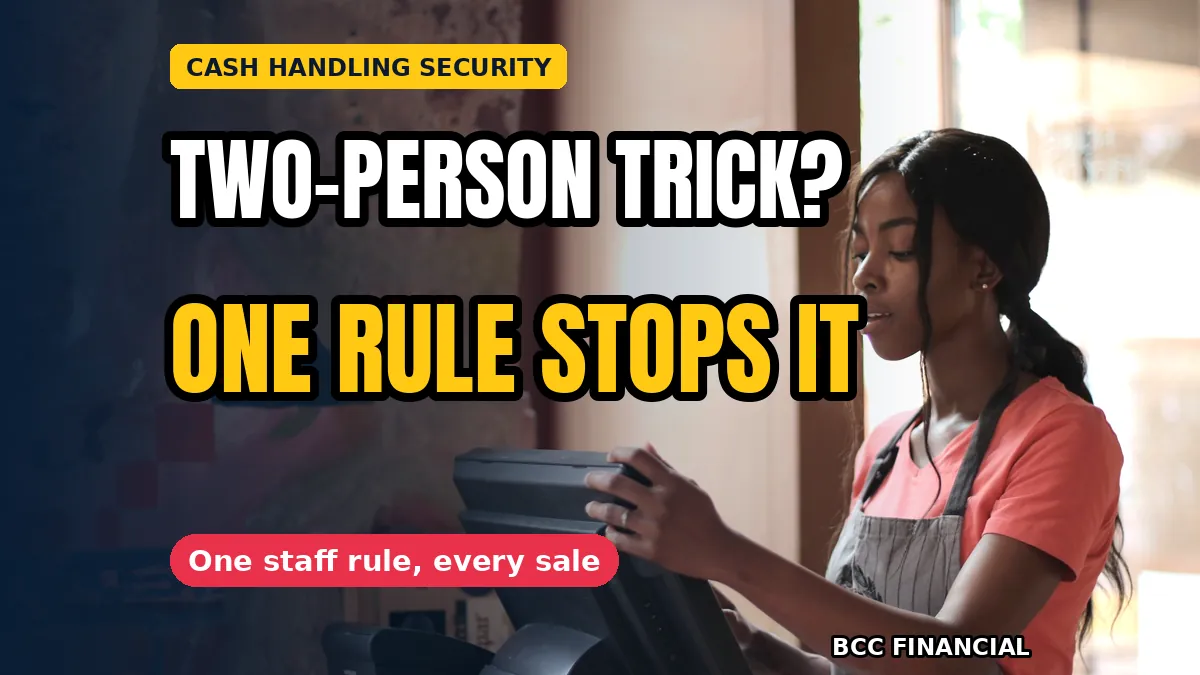
The rule is one sentence long: finish the sale in front of you, close the drawer, and only then deal with the next request. No second request is answered while the drawer is open, and no second person is served while the first sale is unfinished.
It sounds strict, and it is meant to be. A distraction theft till staff rule cash security routine works because it removes the moment the trick needs: the open drawer and the divided attention. With the drawer closed and one sale finished, there is nothing to reach for.
What to Say When a Second Request Arrives Mid-Sale
Staff need words, not just a rule. The line is simple: one moment please, I will finish this sale first and then help you. It is polite, it is true, and it gives the cashier the seconds needed to close the drawer.
Practise the line until it comes out naturally. Our guide to one cashier, one drawer explains the setup that makes the rule easy to follow: one person, one drawer, one sale at a time.
After a Near Miss: What to Record and Who to Tell
If something feels wrong, write it down as soon as the customers have gone: the time, what was said, what the pair looked like, and whether anything is missing. Tell the owner the same day, and check the till against the day’s sales.
Do not chase anyone or accuse anyone at the counter. A note written while the memory is fresh is worth more than a confrontation. Our notes on the fake bank inspection scam cover a different trick with the same lesson: the people who run these attempts count on staff being too polite to pause.
Practise the Rule Before the Busy Season
A rule learned in a quiet week is a rule that holds in a busy one. Walk new staff through the pattern on their first shift, and let them practise the one-moment line with a colleague playing the talkative customer.
The Consumer Financial Protection Bureau’s guidance on fraud and scams explains how to recognise attempts to trick people out of money. At the counter, attention is the target, and a closed drawer is the defence.
Frequently Asked Questions
How can I tell a distraction attempt from a genuine customer?
You often cannot. A distraction theft till staff rule cash security routine does not ask staff to judge people; it asks them to finish one sale and close the drawer before dealing with the next request, whatever the reason for the request.
What if two customers genuinely need help at once?
A distraction theft till staff rule cash security routine says: finish the sale in front of you first, close the drawer, and then help the second customer. A genuine customer will wait a few seconds, and the rule costs them nothing, while it takes away the moment a trick needs.
Should the cashier confront someone they suspect?
No. Stay polite, finish the sale, close the drawer, and write down what happened afterwards. Confrontation risks a genuine customer and a scene, while a quiet note and a till check protect the business.
Does the rule apply to card payments too?
Yes. A distraction theft till staff rule cash security routine is about the cashier’s attention, and a card payment can be muddled by the same trick: finish one payment, confirm it went through, and only then start the next.
Distraction theft works because it splits a cashier’s attention at the exact moment the till is open. Finish the sale, close the drawer, and only then deal with the next request, every time, for every customer. A distraction theft till staff rule cash security routine is one sentence long, and it is the cheapest protection a till has.
If till routines and staff training are taking time away from serving customers, BCC Financial can help with a steadier counter routine. Get in touch to talk through your tills.
This article is general information for business owners and is not financial, legal, or tax advice. Cash handling and security arrangements vary by business and location, so check what applies to you or speak with a qualified professional.