Duress Codes and the Robbery Response: What Every Cash Handler Rehearses Before It Is Ever Needed
A duress code robbery response cash handler procedure is the plan a business makes on a calm day, so that nobody has to invent one on the worst day. It agrees a quiet signal that tells colleagues help is needed, it sets compliance as the rule during the incident, and it writes down who is called and what is recorded once the danger has passed. The plan is rehearsed before it is ever needed, because a procedure nobody has practised is only a piece of paper.

- Agree the signal.
- Practise it in calm.
- Keep it quiet.
- Comply; do not resist.
- Notice only what is safe.
- Lock up, call, write it down.
A duress code robbery response cash handler procedure begins on a quiet day
Start by deciding, in writing, what each person does when a robbery begins, and keep it short enough to remember under stress. One person handles the counter, one person watches for the chance to raise the alarm safely, and everyone knows the signal that means help is needed. A plan that fits on one page will be read; a plan that runs to ten pages will sit in a drawer.
Agree the plan with the whole team, including new starters, and check it against your insurer’s requirements and the advice of your local police. A duress code robbery response cash handler procedure that clashes with what your insurer expects can cost you twice, so the written plan should match the cover you hold. Review it whenever staff change or the alarm system is replaced.
The duress signal itself: agreed, simple, and kept quiet
In a duress code robbery response cash handler procedure, the signal can be a code entered into the alarm panel, a phrase spoken into a phone call, or a word dropped into an ordinary sentence at the counter. Whichever form it takes, it must be simple to use while frightened, hard to trigger by accident, and understood by everyone on the team. A complicated signal fails at the very moment it is needed.
Many alarm panels allow a duress code that disarms the system while silently alerting the monitoring station, and a spoken code word can work the same way on the phone. Practise both in a quiet moment, so the fingers and the voice know what to do without thinking. A duress code robbery response cash handler procedure that has never been tried out is a guess.
During the incident: comply, stay calm, notice
Compliance is the rule in a duress code robbery response cash handler procedure while the incident is happening. Hand over what is asked for, move slowly, keep your hands visible, and do nothing that could be read as resistance. No amount of cash in the till is worth a life, and no one will be praised for being brave with someone else’s safety. The person at the counter is not expected to be a hero, and the plan should say so in plain words.
Stay calm enough to notice what you can: height, build, clothing, voice, and anything unusual about the person, without staring. Do not chase anyone who leaves, and do not follow them outside. Our guide to cash routines for lone workers covers the same first rule for someone working alone: your safety comes before the money.
Raise the alarm only when it is safe to do so. A silent signal pressed while the person is watching puts everyone at risk, so wait until the danger has passed or the person’s attention is elsewhere.
After it ends: lock up, call, write it down
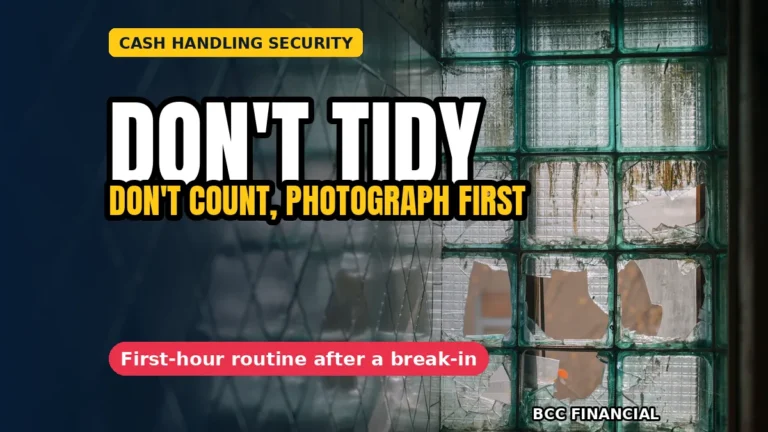
Once the person has left, lock the doors, stop trading, and call the police and your manager. Do not touch anything the person touched, do not tidy the counter, and do not let customers wander through the area, because the scene is evidence until the police say otherwise. A duress code robbery response cash handler procedure that ends at the alarm is only half a plan; the hour after matters just as much.
Write down what happened while it is fresh: the time, what was said, what was taken, and the details you noticed about the person. Ask other staff and customers to write their own accounts separately, before they compare notes. Our guide to robbery prevention basics for cash businesses sets out deterrence, visibility, and a calm response plan. The US Small Business Administration’s guide to preparing your business for emergencies explains why a written plan, practised in advance, is what turns a frightening day into a managed one.
Rehearsal and support: the plan only works if people practise it
Rehearse the plan as a tabletop exercise first, talking through each step with the team, and then walk through it on the shop floor. New starters should hear it in their first week, and the whole team should revisit it twice a year, until the duress code robbery response cash handler procedure feels like a habit.
Support the staff afterwards, without a deadline on it. Some people are shaken for an hour and some for weeks, so offer time off, a change of duties, and someone to talk to. A team that feels looked after after a robbery is a team that will follow the plan again.
FAQ
What is a duress code, exactly?
It is a signal agreed in advance that tells colleagues or an alarm monitoring station that help is needed, without alerting the person causing the danger. It can be a code on an alarm panel or a phrase in an ordinary sentence.
Should staff try to stop a robber?
No. A duress code robbery response cash handler procedure always puts compliance first: hand over what is asked for, stay calm, and let the person leave. Chasing or resisting risks lives, and no till holds enough money to justify that risk.
How often should the team rehearse the plan?
Talk it through with the whole team at least twice a year, and with every new starter in their first week. Rehearsal is what turns a duress code robbery response cash handler procedure into a habit, and a habit is what survives the first seconds of a real incident.
Who should know the duress code?
Only the staff who may need to use it, and the alarm company or monitoring station that must act on it. Keep it out of customer-facing documents and change it whenever someone who knew it leaves the business.
Conclusion: Rehearsed in Calm, Ready When It Counts
A duress code robbery response cash handler procedure is three promises kept in advance: a quiet signal everyone knows, compliance during the incident, and a clear after-plan that covers the call, the record, and the care of your people. Rehearse it, review it, and keep it private.
BCC Financial’s Cash Handling Security guides cover the same ground for lone workers, robbery prevention, and the records that protect your staff and your takings, and they are worth reading alongside this plan.
What you have read here is general information, not guidance for a specific premises or incident. Follow your insurer’s terms and the advice of your local police when you write your own response plan.